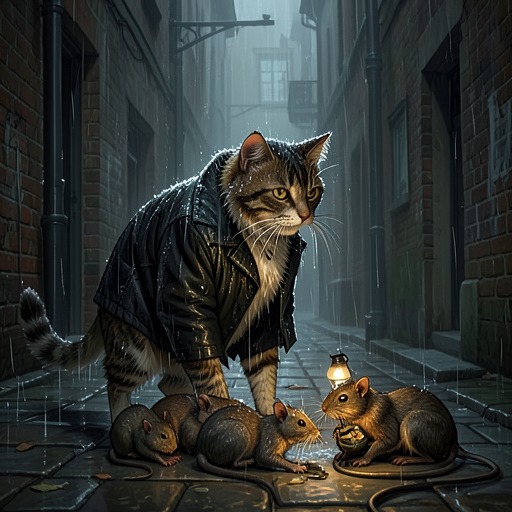
Maurice decides to return and help his companions
The Amazing Maurice and His Educated RodentsMaurice decides to return and help his companions when the Clan’s need makes escape no longer feel like an adequate answer. The choice begins with Hamnpork’s capture, but it carries a deeper cost: Maurice must confront the difference between the cat he once was and the thinking creature he has become. His help is hesitant, his reasons initially tangled with fear, and his resolve is sharpened by the truth he finally admits about how he became Changed.
Causes and Background
The decision unfolds amid the Clan’s crisis. The rats have been exposed to fear powerful enough to make some of them forget how to speak; Peaches watches frightened rats run past, and Dangerous Beans recognizes that their ability to talk has vanished. Elsewhere, the Clan’s identity has been deliberately set against darkness: Dangerous Beans has argued that controlling fire lets the rats declare that they are separate, more than merely rats, and members of the Clan. That aspiration to act as a community is now tested by panic and capture.
Hamnpork’s disappearance gives the crisis a specific demand. Darktan explains that the rat-catchers have taken the Clan’s leader and asks Maurice whether he will help. His appeal rests on belonging and responsibility: Hamnpork is one of them, and the Clan follows its leader. Maurice has already questioned whether Hamnpork is the right leader, pointing to his age and lack of judgment, but Darktan’s answer leaves little room for that objection. The immediate issue is not whether Hamnpork is an ideal leader; it is that the rat-catchers have seized one of their own.
Maurice is not initially standing confidently beside the rats. He is in a pipe, unable to turn around when he thinks he hears scrabbling at its far end. The sound makes him feel exposed, and he agrees to help in a hurry. When Peaches asks whether he truly means it, he repeats his assent, then crawls out and looks back along the pipe. There are no rats there. The small, uneasy gesture captures the decision’s first stage: he has agreed before he has settled his fear, and must now make the promise his own.
From Reluctant Agreement to Return
Maurice’s understanding of the danger is shaped by what he has seen of rat-coursing. He describes a contest in which rat-catchers bring live rats, put them into a wooden ring, and set terriers among them. The rats mostly run in circles rather than fight. Darktan struggles to understand why they do not resist, but Maurice explains that many frightened rats, surrounded by the smell of one another’s panic, can behave as a mob rather than as brave individuals. He compares such a group to one large animal with many legs and no brain.
That explanation is also an uncomfortable description of the fear now spreading through the Clan. Dangerous Beans asks whether Maurice is right that a collection of rats is merely a mob. Maurice begins to answer, then breaks off to disclose that something in a cellar is putting a voice into people’s heads. Peaches observes that the influence affects some creatures and not others: it did not frighten her, Dangerous Beans, or Darktan, while it made Hamnpork angry. Her question presses beyond the immediate rescue and toward what Maurice knows, and what he has avoided saying.
The decision therefore grows out of two forms of responsibility. Maurice has accepted Darktan’s request to help recover Hamnpork, but Peaches’s scrutiny also makes evasion harder. When she points out that Maurice asks people before eating them, she touches the moral change he has not yet explained. His own thoughts urge him to tell the others; he tries to silence them, resenting the conscience that has made him think about the consequences of his past. The choice to go back is not a polished declaration of courage. It is a movement from frightened assent toward deliberate accountability.
The Confession Behind the Choice
Maurice’s admission exposes the history beneath his changed conduct. Dangerous Beans says he misses a rat who had been wonderful once people got him talking, and Peaches asks Maurice directly whether he knew that rat. Maurice finally confesses that he ate him, describing how he had not yet learned to think, had been hungry, and had understood cats to eat rats. The rat had eaten the strange substance on the dump; after Maurice ate the rat, Maurice became Changed too. He says that he did not know the rat was someone, or that he himself was someone.
The confession does not undo the killing, and it does not make Maurice’s guilt disappear. It does, however, distinguish the ignorance of his former life from his present awareness. Peaches responds that it happened a long time ago, and Maurice clarifies that he has not eaten anyone since. The exchange matters to the decision because his new obligation is not abstract: he now recognizes other thinking beings as people whose lives count. Helping the Clan is consistent with that recognition, while abandoning them would mean retreating into the old rule that a cat simply behaves as a cat.
Maurice’s inward resistance continues even after the confession. He thinks that thinking has brought him trouble: once he recognizes that others can think for themselves, he also begins thinking on their behalf. He groans, then says that they should find out what has happened to the kid. The narrative moves from his private moral struggle to the immediate action: the cellar is completely dark, with only the occasional drip of water and the voices of those inside, including Malicia. His return is thus not only a promise to assist the Clan; it carries him toward another endangered companion.
Significance and Consequences
Maurice’s choice contrasts sharply with his account of rat-coursing. In the ring, panic turns many rats into a running mass; in the Clan’s crisis, fear threatens to dissolve speech and shared identity. Later, Darktan rallies the rats by naming their capacity to think and act together, and the Clan advances in a line that closes around attackers rather than scattering. Those later scenes give collective action a concrete form, but they do not erase the difficulty that Maurice faces here: before solidarity can become an organized response, individuals must choose not to abandon one another.
The decision also develops the book’s distinction between mere survival and moral agency. Maurice’s first answer is hurried, and his unease does not vanish; what changes is that he stops treating fear as sufficient reason to stay away. The earlier declaration that the Clan is separate from ordinary rats gains practical weight when its members are captured, frightened, or in need of rescue. Maurice’s return joins his personal transformation to that communal claim: he has become capable of recognizing another’s personhood, and that recognition now obliges him to act.